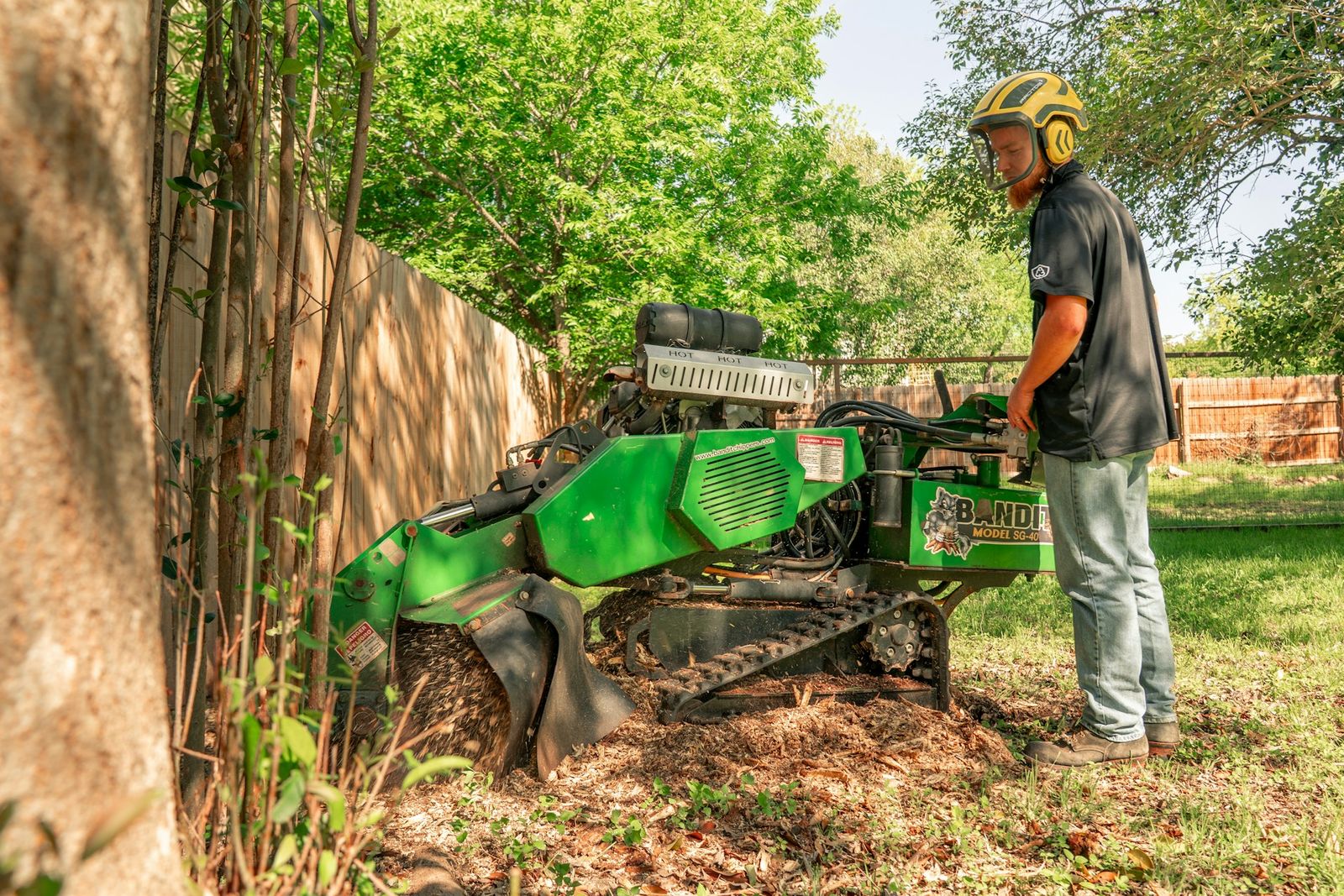
If most of the crown is alive and the trunk is sound, trimming will usually do. A split trunk, or a crown with less than half left, usually means the tree should come out. In Fort Worth the choice also changes your paperwork, because removing a tree on private property is what the city's permit line is about, and the form for a dead or hazardous tree asks for proof.
The signs, in plain terms
Texas A&M Forest Service treats one lost major limb as something a mature shade tree can usually live through, though recovery gets harder as the broken limb gets bigger. It leans toward removal for a split trunk, and for a crown so reduced it may not leaf out enough to keep the tree going. It also asks a question people skip: is this a tree you want in this spot? A big tree growing under a power line may be better out now than later, it says.
ISA, the International Society of Arboriculture, publishes a checklist and says a yes to any item means an ISA Certified Arborist should look at the tree. Look for:
- Large dead branches, or ones already hanging loose or fallen
- Loose bark, or cracks in the trunk or where branches join it
- Rotten wood, cavities, or mushrooms at the base
- Recent construction, soil changes or new paving around the roots
- Leaves that are smaller or yellower than usual
- Past topping or heavy pruning
Cracked or lifted soil at the base is one to take seriously, ISA says, above all with a leaning tree. Two main stems splitting from one trunk can often be a failure point too.
What Fort Worth's form wants if it is coming out
For a tree that is dead, dying or hazardous, the city's Tree Removal Application asks for photos and, as part of its documentation list, a signed letter or other document such as an ISA Tree Risk Assessment from a certified arborist or similar professional. So get that opinion on paper before the tree is gone. Once it is on the ground, nobody can inspect it standing. The permit page quotes what the city says and who to ask.
Species matters too. A healthy pecan or live oak is on the ordinance's protected list, and at 24 inches across it counts as significant. A trim that fixes the problem may save you a harder permit. Hackberry, which the city's tree guide calls common in north and south Fort Worth, is on the unprotected list instead. Ask the office what that changes for yours.
Limbs near wires
Oncor handles this in two ways, depending on the wire. For the service line, running from the pole to your meter, it says to call a qualified tree trimmer or arborist, and to contact your electricity provider to ask for a temporary disconnect and reconnect. Oncor then lowers the line so the work can be done safely, and puts it back afterward. It says there is a nominal charge, and your provider can tell you what.
For other lines, such as high voltage ones, it says customers "shall not go or bring any materials within 10 feet" and should contact Oncor to make arrangements. Texas law sets its own six-foot limit on high voltage lines unless the danger is guarded against, and section 752.003 makes whoever is responsible for temporary work that close tell the line's operator 48 hours ahead.
Oncor also trims on its own rotation. Its FAQ says a minimum of 10 feet is cleared from high voltage primary lines, including overhang, and at least 7 feet around open wire secondaries. If that leaves your tree badly shaped, that is the point to ask whether it is still worth keeping.
Corner lots and parkway limbs
The city's parkway guidelines, revised in August 2020, call for a 40-by-40-foot triangle of open space at street corners, and nothing, trees included, may block the view from 24 inches to 11 feet above the curb. No tree may hide a traffic signal or sign either. So a corner lot can need trimming for reasons that have nothing to do with the tree's health, and the MyFW list has a request for visibility hazards. A limb on a parkway tree needs Forestry's pruning permit, not just a saw.
Topping is not a compromise
You may hear "just take the top out" as the cheap way to make a big tree safer. ISA says topping is "perhaps the most harmful" pruning practice there is, and that the cut can remove half or more of the crown's leaves, sometimes all of them. The regrowth hangs on weakly and snaps easily in wind or ice, and those are the two things this area's storms bring. Other names for it are heading, tipping, hat-racking and rounding over. If a tree really is too big for its spot, ISA's advice in its risk brochure is that trees with unmanageable risk are best removed and replaced.
Two local exceptions
An oak cut in spring is a different job from one cut in January, whether you trim or remove, because of oak wilt timing. See the oaks page. And trimming does nothing for an ash with emerald ash borer in it. The ash trees page covers that decision.
Limbs from next door
By the Texas State Law Library's account, the person next door may cut overhanging limbs back to the property line, and can be sued for injuring the tree or anything else while doing it. It adds that Texas has no specific statute on this, only court cases. Talk first and cut second.
Who should make the call
A company paid for removals has a reason to recommend one, so get more than one estimate, as ISA advises. Its directory lets you look up a credential, though listings are voluntary. We do not check anyone's credentials ourselves.
Phone line opening soon
Allow us to connect you to a local pro.
Sources
- Can My Tree Be Saved?, from Texas A&M Forest Service
- Recognizing Tree Risk, a brochure from the International Society of Arboriculture (PDF, 2021)
- City of Fort Worth, Tree Removal Application for private trees (PDF; cites Ordinance 27615-04-2025)
- City of Fort Worth, Urban Forestry Ordinance, Section 6.302 of the Zoning Ordinance with the amendments passed April 22, 2025 (PDF linked from the city page)
- City of Fort Worth, Geographic/Ecological Regions of Fort Worth Trees (PDF, undated)
- Oncor, FAQs on outages, equipment and tree pruning
- Section 752.004 of the Texas Health and Safety Code, read on Public.Law
- Section 752.003 of the Texas Health and Safety Code, read on Public.Law
- City of Fort Worth, Application for Tree Removal Permit on city property, with parkway guidelines (PDF, revised August 2020)
- City of Fort Worth, MyFW app and reporting page
- City of Fort Worth, Park & Recreation Forestry page (city trees, hazard reports, permits, priority list)
- Why Topping Hurts Trees, a brochure from the International Society of Arboriculture (PDF, 2021)
- Identifying and managing oak wilt, the Texas A&M Forest Service brochure (PDF)
- Trees, in the Neighbor Law guide from the Texas State Law Library (updated September 1, 2026)
- Why Hire an Arborist?, a brochure from the International Society of Arboriculture (PDF, 2021)
- The credential lookup at TreesAreGood.org (listing is voluntary)
Read on 2026-11-05. External pages can change.